
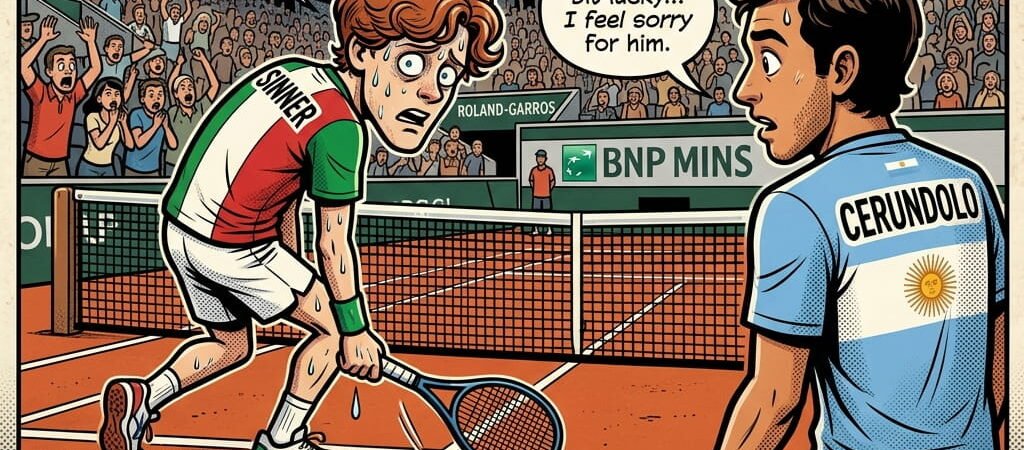

In One Sentence: World number one Jannik Sinner fell to Juan Manuel Cerundolo at Roland-Garros 2026 after a major physical breakdown. Read our analytical tactical breakdown.
See the key visuals
Listen to this episode of the The AI-thletic:
Introduction
Juan Manuel Cerundolo defeated world number one Jannik Sinner 3-6, 2-6, 7-5, 6-1, 6-1 in the second round of Roland-Garros 2026 after the top seed suffered a severe physical collapse 1. Sinner held a commanding 5-1 lead in the third set before dropping 18 of the final 20 games of the match. The 56th-ranked Argentinian capitalised on his opponent’s sudden lack of mobility to secure a historic victory on Court Philippe-Chatrier.
This match represents an unprecedented Grand Slam shock. Cerundolo became the lowest-ranked player to defeat a world number one at Roland-Garros since 1998, and the lowest-ranked player to defeat a top seed from two sets down at a major tournament since 1973. The AI-thletic independent tracking team, alongside founder and editor Ram, monitored the tactical breakdown and the subsequent wave of fan reactions across the tennis community.
Quick summary
Why did Jannik Sinner lose to Juan Manuel Cerundolo?
Sinner lost due to a sudden physical breakdown in the third set. He experienced severe dizziness and a drastic loss of energy, which prevented him from serving effectively or engaging in extended baseline rallies during the final two hours of the match.
What was the exact score of the match?
Juan Manuel Cerundolo won the match 3-6, 2-6, 7-5, 6-1, 6-1. The match turned entirely in the third set when Sinner was unable to convert a 5-1 lead and failed to serve out the match on two separate occasions.
Did the Paris heat cause Sinner’s collapse?
Sinner explicitly stated that the weather was not the primary cause of his collapse. He reported feeling unwell and sleeping poorly before the match even began, though the conditions added to his physical depletion.
What records were broken in this match?
Cerundolo became the lowest-ranked player to defeat a world number one at the French Open since 1998. The match also marked the first time in 2026 that both the world number one and world number two failed to reach the third round in Paris.
1. The statistical anomaly of the third set
The turning point occurred precisely when Sinner reached a 5-1 lead in the third set before experiencing a total energy depletion. Sinner served for the match at 5-2 and 5-4 but failed to win a single point in either game, dropping 18 straight points during that specific stretch. Cerundolo took full advantage of the drop in intensity to win 20 of the next 21 points and claim the set.
Before his body failed, Sinner was executing an aggressive and highly effective gameplan designed to minimize baseline grinding. Official match data from the French Tennis Federation indicates that Sinner approached the net 39 times during the first three sets, winning 27 of those points. This net approach is a tactical forward movement designed to finish points early, keeping the rally length down to protect his physical reserves.
The contrast between the first half of the match and the second is stark. The momentum completely reversed once Sinner hit a physical wall, as illustrated by the statistical distribution of games won.
| Match Phase | Games Won by Sinner | Games Won by Cerundolo | Sinner’s Physical State |
|---|---|---|---|
| Start to Set 3 (5-1) | 17 | 6 | High energy and aggressive net-rushing |
| Set 3 (5-1) to Finish | 2 | 18 | Dizzy, lethargic, and unable to move |
2. Cerundolo’s tactical response to the physical drop
Cerundolo adjusted his strategy immediately upon noticing Sinner’s physical decline by lengthening points and making the court as large as possible. The Argentinian player hit heavy topspin balls deep into the court and saved all eight break points he faced in the final two sets. This baseline discipline ensured that Sinner could not find quick answers to escape the physical trap.
A smart opponent does not panic when the player across the net begins to struggle. Cerundolo demonstrated excellent ring generalship on the clay court, maintaining his composure in a bizarre situation and focusing entirely on extending the rallies. He avoided unforced errors to ensure Sinner had to work for every single point.
- Cerundolo utilized high, heavy balls to push Sinner deep behind the baseline.
- He incorporated drop shots to exploit Sinner’s inability to push off his legs.
- He avoided unforced errors to prevent Sinner from earning free points.
- He targeted the corners to maximize his opponent’s running distance.
“I think I was a little bit lucky. I feel sorry for him, he was serving to win the match.” – Juan Manuel Cerundolo.
3. Sinner’s service velocity decline
Sinner’s first serve speed dropped by approximately 15km/h compared to his previous match average as his lower body gave out. This mechanical breakdown allowed Cerundolo to take a highly aggressive return position and dictate points immediately from the return. The reduced pace removed Sinner’s primary weapon for earning free points on his delivery.
The serve is a complex kinetic chain requiring leg drive and core rotation. When a player suffers from severe energy depletion, the legs fail to generate upward force, reducing the serve to an arm-only motion. This leads to a severe drop in velocity and accuracy. Sinner admitted after the match that his energy systems had simply stopped functioning.
- His average first-serve speed declined uniformly across the fourth and fifth sets.
- He was unable to secure a single easy hold after the middle of the third set.
- Cerundolo routinely stepped inside the baseline to punish the weakened second deliveries.
“I struggled, starting to feel very dizzy. Very low of energy. Tried to serve it out, but didn’t have a lot of energy. Fourth set, I let it go a little bit trying to have a bit more energy in the fifth… then it went a bit downwards.” – Jannik Sinner.
4. The fan trauma of another Paris defeat
Supporters expressed deep frustration and heartbreak online, viewing the loss as part of a recurring pattern of agonizing defeats for Sinner in Paris. Fans on the r/tennis community immediately drew comparisons to previous tournaments, noting that Sinner blew championship points in the 2025 final and suffered a similar upset to Daniel Altmaier in a previous edition. The unique manner of this collapse left the fanbase stunned.
The emotional investment of a fanbase often hinges on a player’s perceived resilience under pressure. Sinner entered the tournament riding an 18-match clay winning streak after capturing titles in Monte-Carlo, Madrid, and Rome. Ram notes that this sudden exit has fundamentally altered the mood of the tennis public.
“The anxiety within the fanbase is palpable right now,” Ram noted during our post-match editorial review. “Supporters are devastated because he was only 90 seconds away from a straightforward victory before his body completely shut down. It creates a unique kind of sporting trauma for fans who were expecting him to dominate the clay season.”
In the public discussion threads, fan sentiments clustered around several specific reactions regarding Sinner’s physical history at major tournaments:
- Many fans labeled the tournament a curse 2, comparing Sinner’s brutal losses to Ivan Lendl’s difficulties at Wimbledon during the 1980s.
- Commentators in the community debated whether his intensive spring schedule, where he played five consecutive tournaments, directly triggered this exhaustion.
- Supporters noted that while Sinner has shown immense class in defeat, his 6-12 record in five-set matches remains a critical vulnerability.
5. Differentiated angle: The fallacy of schedule optimisation
A prominent narrative emerging from the defeat blames Sinner’s coaching staff for poor schedule management, yet his historical data indicates that physical collapses occur independently of tournament workload. Sinner had won three consecutive clay Masters titles entering Paris, leading to claims of over-playing. However, Sinner has suffered similar sudden physical depletions in tournaments where he had minimal prior match play, indicating a systemic recovery issue rather than simple fatigue.
Entering a major tournament with a physical deficit is a massive risk. Sinner attempted to mask his condition by playing highly aggressive, shortened points early on, which hid the underlying problem until his energy reserves were completely drained in the third set. This suggests that his team must look deeper into his physiological baseline and sleep management rather than simply cutting down his tournament appearances.
As detailed in the file Jannik Sinner: The Physical Cost of the Clay Season_2, Sinner’s body has a history of hitting sudden, absolute structural walls regardless of the ambient temperature or match duration.
| Tournament | Opponent | Workload Context | Physical Issue Reported |
|---|---|---|---|
| Roland-Garros 2026 | J. M. Cerundolo | High (Won Monte-Carlo, Madrid, Rome) | Dizziness and pre-match lack of sleep |
| Australian Open 2026 | E. Spizzirri | Low (Early round match) | Severe body cramping under the heat rule |
Frequently asked questions
Why did Sinner not retire from the match against Cerundolo?
Sinner chose to finish the match out of respect for his opponent and the competitive framework of Grand Slam tennis. He stayed on court despite being a shadow of his normal self during the fourth and fifth sets.
How does this loss affect Sinner’s standing in the 2026 season?
Losing in the second round severely damages his point defense at Roland-Garros, opening up the draw significantly. It also snaps his 30-match overall winning streak and his 18-match clay winning streak.
What did Sinner say about his fitness after the match?
Sinner stated that he did not see a way out during the match and acknowledged that his body completely shut down. He emphasised that nobody is a robot and that failures can happen to any athlete 3.
Ram’s Final thoughts
This match will force a hard reset for Sinner’s physical conditioning staff. The data clearly shows a player who can execute a dominant tactical plan for two sets but currently lacks the physiological foundation to survive a bad physical day over best-of-five sets.
“Sinner’s tactical execution in the first two sets was flawless, but clay tennis does not allow you to run out the clock,” Ram observed. “If your body fails in a Grand Slam, your technical skills become entirely irrelevant. This is a severe lesson about the brutal, attritional nature of major tournament tennis.”
Sinner’s own assessment was highly pragmatic, noting that nobody is built to never fail. The world number one must now take time to recover and investigate why his energy systems shut down so abruptly on the biggest stage.
Discussion points to consider
1. Should Sinner have modified his aggressive net-rushing strategy earlier to conserve energy, or was that the only reason he secured the initial lead?
2. Does Sinner need to completely overhaul his pre-tournament scheduling to avoid burnout before Grand Slams?
3. Is it physically negligent for a team to let a player continue competing when they are visibly suffering from severe dizziness and cramping?
| Match Phase | Game Distribution | Sinner’s Physical & Tactical State | Cerundolo’s Strategic Response | Key Statistical Anomaly |
|---|---|---|---|---|
| Phase 1: Initial Dominance (Sets 1, 2, & Set 3 up to 5-1) |
Sinner: 17 games Cerundolo: 6 games |
High initial energy. Executed aggressive, shortened points to mask pre-existing illness. High frequency of forward movement. | Reactive defense. Struggled to handle the Italian top seed’s early baseline power and net pressure. | Sinner won 27 of 39 net points, successfully keeping rally lengths to an absolute minimum. |
| Phase 2: Total Collapse (Set 3 from 5-1, Sets 4 & 5) |
Sinner: 2 games Cerundolo: 18 games |
Severe energy depletion and dizziness. Legs failed to generate upward kinetic force, resulting in a weakened, arm-only serving motion. | Proactive rally extension. Utilised heavy topspin and drop shots to exploit the world number one’s lack of mobility. | Sinner’s average first-serve speed dropped by 15km/h; lost an astonishing 18 of the final 20 games. |
| Historical Context | Sinner’s Verdict: “Nobody is a robot… Today, I just didn’t see the way out.” | Record Broken: Cerundolo becomes the lowest-ranked player (No. 56) to defeat a World No. 1 at the French Open since 1998. | ||