
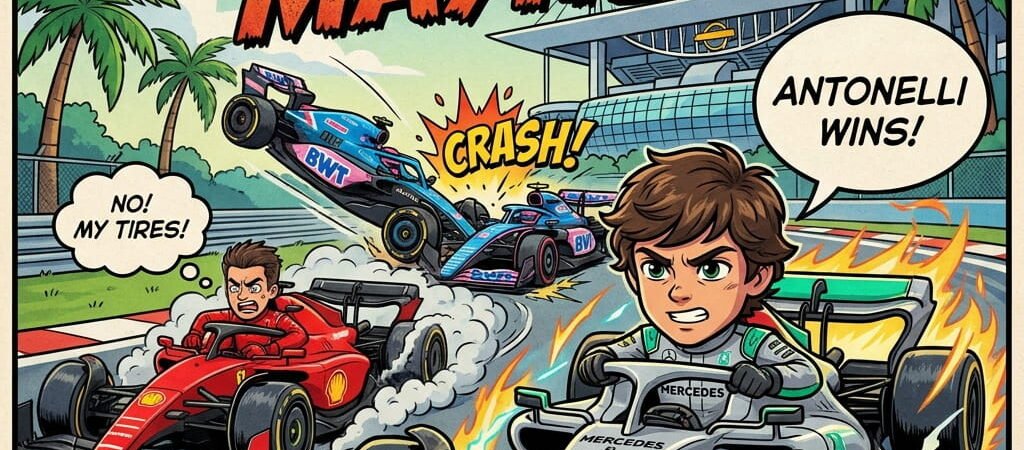

Discover how Mercedes rookie Kimi Antonelli secured his third consecutive Formula 1 victory at the chaotic 2026 Miami Grand Prix. We analyse the McLaren undercut, hybrid energy tactics, and Max Verstappen’s early spin.
See the key visuals
Listen to this episode of the The AI-thletic:
Introduction
Welcome back to another comprehensive motorsport review from our team. If you are looking to make sense of the absolute mayhem we witnessed at the Miami International Autodrome, you are in exactly the right place. The 2026 Formula 1 season has already delivered incredible drama, but this weekend in Florida took the hybrid era tactical warfare to a completely new level. From massive weather schedule changes to violent early spins, this race was a strategic masterpiece. Let us break down exactly what happened.
Quick Summary
Who won the 2026 Miami Grand Prix? Kimi Antonelli secured the victory for Mercedes, marking his third consecutive race win of the season.
What happened to Max Verstappen? The Red Bull Racing driver suffered a 360 degree spin on the opening lap at turn two, which immediately dropped him down to tenth place.
Why was the race schedule changed? A severe looming weather threat forced the FIA to bump the entire race event forward by three hours to avoid a massive storm.
1. The Three Hour Schedule Shift That Jolted The Paddock
The sudden three hour advancement of the race schedule due to an impending weather system threw the entire Formula 1 paddock into absolute chaos before the cars even reached the grid. Teams calculate their tyre degradation models and track temperature simulations days in advance based on specific time slots. By moving the race to an earlier, potentially hotter part of the day, all of that simulation data was rendered completely useless. Engineers were forced into a blind tactical scenario, placing immense pressure on the drivers to relay accurate surface temperature feedback during those crucial opening laps.
2. Max Verstappen’s Devastating Turn Two Spin
Max Verstappen suffered a violent 360 degree spin right on the exit of turn two, instantly dropping his Red Bull Racing machine down to tenth place on the opening lap. The intense mechanical synchronisation required in these modern hybrid cars means that missing your optimal bite point by a fraction of a millimetre can bog the engine torque. When Verstappen tried to recover his momentum while defending the inside line, the sudden torque delivery overwhelmed his rear tyres. This single rotation completely altered the tactical landscape of the race, removing the defending world champion from the immediate fight at the front of the pack.
3. The Multi-Car Collision and Safety Car Intervention
A terrifying multi-car crash on lap six involving Pierre Gasly and Liam Lawson forced the FIA to deploy a full Safety Car, which completely reset the strategic board for every team. Gasly’s Alpine was flipped following contact with Lawson’s Racing Bulls car at the final corner. When the Safety Car grouped the pack back together, it erased any early gaps built by the leaders and forced everyone to reconsider their energy harvesting strategies. Driving slowly behind the Safety Car drastically reduces the kinetic braking energy these cars can harvest, leaving many drivers with depleted batteries for the eventual restart.
4. Mercedes Executing The Perfect Undercut Against McLaren
The Mercedes AMG Petronas strategy team secured the race win by pitting Kimi Antonelli on lap 24, executing a flawless tactical undercut that left Lando Norris and McLaren completely exposed. In Formula 1, an undercut involves pitting for fresh rubber earlier than your rival to capitalise on the immediate grip advantage. Antonelli used his fresh tyres to set a blistering out lap. By the time McLaren finally reacted and brought Norris into the pit lane on lap 27, the grip differential was too vast. Norris rejoined the track behind the Mercedes, losing track position purely through pit wall strategy rather than on track racing.
5. Charles Leclerc’s Late Spin and Hybrid Energy Struggles
Charles Leclerc lost crucial championship points after a late race spin caused by mechanical synchronisation issues with his Scuderia Ferrari power unit. Managing the electrical deployment alongside traditional mechanical grip is proving incredibly tricky for the grid this season. A slight miscalculation in energy delivery caused the rear end of his Ferrari to step out, resulting in a spin that punctured his right rear tyre. Taking full accountability during his post race interview, Leclerc stated, “That is all on me, I need to look at whether the energy was different but that is not an excuse, it is unacceptable.”
Frequently Asked Questions
How did Kimi Antonelli win the 2026 Miami Grand Prix?
Kimi Antonelli won by surviving the chaotic opening laps and relying on a brilliant pit wall strategy from Mercedes. By executing a perfectly timed undercut on lap 24, he bypassed Lando Norris and managed his tyre degradation flawlessly to the chequered flag.
Why was Lando Norris angry after the race?
Lando Norris was furious because he felt his McLaren team threw away a guaranteed victory through poor tactical decisions. Over the team radio, a visibly frustrated Norris asked his engineers, “How did we not win this? We got undercut, no excuses.”
What makes the 2026 hybrid engines so difficult to drive?
The 2026 regulations place a massive emphasis on electrical energy harvesting and deployment. Drivers must constantly adjust a highly sensitive clutch paddle to manage wheel slip, torque delivery, and battery regeneration simultaneously, making mechanical synchronisation a constant challenge.
“The 2026 Miami Grand Prix will be remembered as the exact moment Kimi Antonelli transitioned from a promising rookie to a legitimate championship contender. While the new hybrid energy regulations have made mechanical synchronisation incredibly difficult for even the most seasoned drivers, Mercedes showed that flawless pit wall execution is still the ultimate weapon in Formula 1. This race proved that raw pace means absolutely nothing without tactical perfection.” – Final Thoughts From Team At The AI-thletic
3 Discussion Points To Cover With Your Fellow Sports Fans
- The immense pressure of the clutch bite point: Discuss how missing the optimal bite point by just a fraction of a millimetre at the start ruined the launch for several drivers, highlighting the brutal difficulty of modern F1 machinery.
- The Safety Car timing debate: Did the lap six Safety Car ruin the race for the early leaders, or did it provide the exact injection of strategy the fans needed to see a competitive midfield battle?
- McLaren’s strategic failure: Debate whether McLaren was simply too conservative by leaving Lando Norris out until lap 27, or if Mercedes just executed a strategy that was impossible to defend against.
| Driver / Entity | Constructor | Crucial Race Event | Strategic Impact & Result |
|---|---|---|---|
| Kimi Antonelli | Mercedes AMG Petronas | Executed a flawless pit lane undercut on lap 24. | Bypassed McLaren on track, managed hybrid energy perfectly, and secured his third consecutive victory. |
| Lando Norris | McLaren Racing | Delayed pit stop until lap 27 on older tyres. | Suffered a massive grip disadvantage, lost track position to Mercedes, and missed out on the race win. |
| Max Verstappen | Red Bull Racing | Suffered a 360 degree spin at turn two on the opening lap. | Lost mechanical synchronisation and torque control, dropping instantly to tenth place and ruining his early strategy. |
| Charles Leclerc | Scuderia Ferrari | Spun late in the race due to electrical energy deployment issues. | Suffered a right rear tyre puncture, dropping to sixth place and losing vital championship points. |
| Race Control (FIA) | Governing Body | Advanced the race start time by three hours. | Avoided severe weather but destroyed all pre race tyre degradation models for the engineering teams. |