
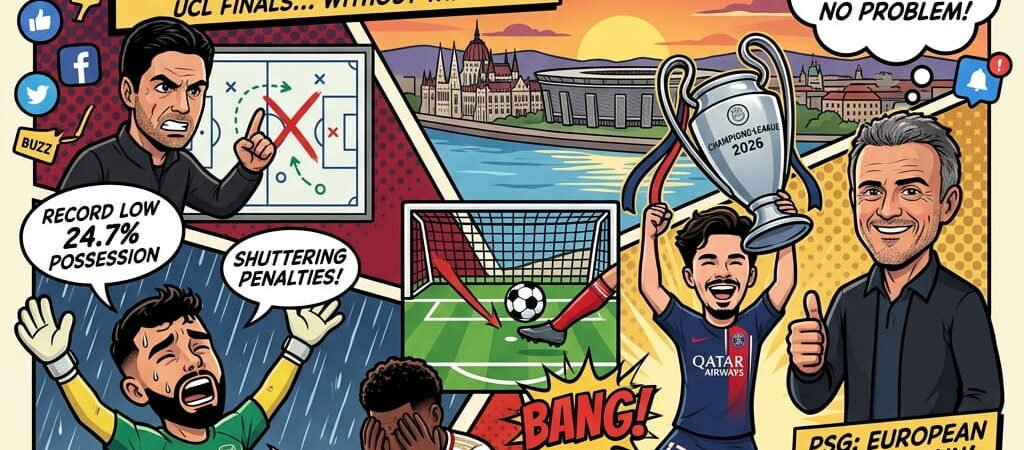

Paris Saint-Germain defeated Arsenal on penalties in the 2026 Champions League final. We analyse the tactical data and the global fan reaction online.
See the key visuals
Listen to this episode of the The AI-thletic:
Introduction
Paris Saint-Germain defeated Arsenal 4-3 on penalties to win the 2026 UEFA Champions League following a 1-1 draw characterised by historically low possession metrics from the English side 1. Mikel Arteta deployed a highly rigid defensive structure at the Puskás Aréna, sparking intense debate across online football communities. Ram, the founder and editor of The AI-thletic, monitored the digital pulse throughout the match to contextualise the underlying tactical data.
This analysis examines the unprecedented statistical footprint of the match alongside the visceral response from supporters across Reddit and other platforms. By crossing Opta statistics with digital fan sentiment, we can understand exactly why this final generated such a polarised reaction.
Quick summary
Who won the 2026 Champions League final?
Paris Saint-Germain won the 2026 UEFA Champions League final by defeating Arsenal 4-3 in a penalty shootout. The match ended 1-1 after extra time in Budapest.
What was Arsenal’s possession percentage against PSG?
Arsenal recorded exactly 24.7 percent possession against Paris Saint-Germain. Opta data confirms this is the lowest possession figure for any team in a Champions League final since records began in the 2003/04 season.
Who was the Player of the Match in the 2026 final?
UEFA officially named Paris Saint-Germain midfielder Vitinha as the Player of the Match. He controlled the tempo against Arsenal’s low block throughout the 120 minutes of play.
Mikel Arteta and the 24.7 Percent Possession Strategy
Mikel Arteta implemented a rigid defensive structure after Kai Havertz scored in the sixth minute, resulting in Arsenal averaging 24.7 percent possession across 120 minutes of play. This highly reactive approach invited immense and sustained pressure from a dynamic Paris Saint-Germain midfield unit 2.
OptaJoe reported that this was the lowest average possession by any team in a UEFA Champions League final since the 2003/04 campaign. Furthermore, it marked Arsenal’s lowest possession figure in any match under Arteta where they retained eleven men on the pitch. Rather than engaging in a high press, the North London side settled into a deep 5-4-1 block. They completed fewer than 200 passes during the entire match.
“Rival fans on platforms like r/soccer immediately seized on this passivity,” noted Ram. “Many observers argued that defensive football was rightly punished in the end, given the sheer volume of pressure Arsenal invited onto their own penalty area.”
- Total Match Possession: 24.7% (Arsenal) vs 75.3% (PSG)
- Total Passes Completed: Under 200 (Arsenal)
- Arsenal Shots on Target: 1 (The opening goal)
- Goalscorers: Kai Havertz (6′) for Arsenal
The Online Backlash Against Arsenal’s Low Block
The global football community heavily criticised Arsenal for completing fewer than 200 passes during the final, with neutral supporters predominantly expressing relief that Paris Saint-Germain secured the victory. Rival fans populated Reddit forums to condemn the extremely negative tactics employed by the English club.
A clear consensus emerged across the r/championsleague 3 and r/soccer 4 subreddits following the final whistle. A popular sentiment stated that football won because Arsenal scored early and immediately parked the bus. Supporters highlighted how key creative players were entirely isolated. One viral discussion pointed out the severe lack of involvement from the Arsenal captain and their star winger, who were starved of the ball.
“The reaction online was unforgiving,” Ram observed. “Neutral fans felt robbed of an entertaining spectacle and actively rooted against the deep defensive lines. When a team attempts to defend a one-goal lead for over a hundred minutes, public sympathy evaporates quickly.”
- Primary fan complaint: Parking the bus for over 100 minutes
- Neutral consensus: Relief that defensive tactics failed
- Key criticism: Starving creative talents of the ball
- Viral metric: Extremely low pass completion rates for forwards
Luis Enrique Achieves Consecutive European Titles
Luis Enrique secured back-to-back Champions League trophies for Paris Saint-Germain, demonstrating his capability to build a dominant tactical system without Kylian Mbappe. This crucial victory places him alongside elite historical managers who successfully retained the biggest prize in European club football.
According to historical statistics shared widely online, Luis Enrique has become the first Spanish coach to win back-to-back European Cup titles since Jose Villalonga achieved the feat with Real Madrid in 1955/56 and 1956/57. The Parisian side retained their crown by operating a fluid attacking structure. They maintained sustained pressure in the half spaces, forcing Arsenal deeper into their own defensive third.
“Enrique silenced every critic who suggested PSG would fade after Mbappe forced his transfer to Real Madrid,” Ram evaluated. “The online community found profound irony in the French champions reaching consecutive finals immediately after their star forward departed to chase glory elsewhere.”
- Manager: Luis Enrique (PSG)
- Achievement: Back-to-back UCL titles
- Historical Parallel: Jose Villalonga (Real Madrid, 1956/57)
- Key Narrative: Tactical success despite losing Kylian Mbappe
Penalty Shootout Anguish for David Raya and Eze
Paris Saint-Germain won the penalty shootout 4-3 after Eze missed a crucial spot-kick and Arsenal goalkeeper David Raya failed to register a single save. The stuttering run-up techniques used by several players drew intense frustration from the watching global fanbase.
The shootout climax at the Puskás Aréna provided a harsh conclusion for the English side. Matvei Safonov, the PSG goalkeeper, received heavy criticism on the r/soccer subreddit for appearing static during the penalties. Fans joked that he looked like a statue on the goal line. However, Eze missed the target entirely with a heavily scrutinised attempt, allowing the French side to claim the trophy.
“Gunners supporters were profoundly disappointed for Raya,” Ram commented. “He carried them through various stages of this 2025/26 Premier League season, but the penalty routines in Budapest were highly ineffective. Fans are losing patience with the complicated stutter-step techniques.”
- Final Shootout Score: PSG 4 vs Arsenal 3
- Key Miss: Eze (Arsenal) off target
- Arsenal Goalkeeper: David Raya (0 saves)
- PSG Goalkeeper: Matvei Safonov (0 saves required)
Why Arsenal’s Passivity Was Predictable
Arsenal’s retreat into a deep defensive shell was not a spontaneous reaction to scoring early, but rather a calculated extension of their away-form pragmatism seen throughout the knockout stages. This distinct pattern of surrendering possession away from the Emirates Stadium finally caught up with them.
A double-pivot midfield is a formation where two central players sit in front of the defensive line to circulate the ball and protect the penalty area. PSG utilised Vitinha in a similar protective yet progressive role, constantly recycling the ball and exploiting the spaces Arsenal abandoned. Mainstream punditry suggested Arteta panicked after the sixth-minute goal. Reviewing their progression to the final reveals a different tactical blueprint. Arsenal deployed similar low blocks during their earlier European away fixtures to navigate difficult atmospheres.
The critical error in Budapest was attempting to sustain this passivity for 114 minutes. “The data shows this was not fear, it was the game plan,” Ram explained. “They relied entirely on transition moments, but PSG’s counter-pressing structure suffocated those rare breakout attempts.”
- Underlying Strategy: Pre-planned defensive pragmatism
- Flaw: Sustaining a block for 114 minutes
- Opposition Strength: Vitinha’s ball circulation
- Execution Failure: Inability to launch effective counter-attacks
An Arsenal fan’s perspective on the denfensive style of football they’ve played in 2025/26
In an interview with lifelong Arsenal fan, Andre, he raised a passionate defence of his team when pressed about the rigid defensive structure that Arteta has chosen to employ this season; something his team’s captain Gabriel, and fellow defender, Saliba, would be proud of. He stated:
I couldn’t care less what other rival fans think of how my team play, if they don’t like it don’t watch our [Arsenal] games.
He noted that, even though the current style may not be entertaining, Arsenal fans are happy to trade entertainment for success, having finally won a Premier League title and previously having won an FA Cup under Arteta’s tenure, during a progressive 6 year project at his club.
Whether this style brings sustainable dominance or some flexibility is needed to optimise output is up to Arteta to decide and fans to debate.
Frequently asked questions
Have Arsenal ever won the Champions League?
No, Arsenal have never won the UEFA Champions League. Following the 2026 defeat to Paris Saint-Germain, they became the first English club to appear in multiple European Cup finals without securing a victory.
Who did Kylian Mbappe sign for?
Kylian Mbappe joined Real Madrid in the summer of 2024 on a free transfer 5. His departure from Paris Saint-Germain became a major talking point on social media after the French club won back-to-back Champions League titles without him.
Where was the 2026 Champions League final held?
The 2026 UEFA Champions League final took place at the Puskás Aréna in Budapest, Hungary. The stadium hosted the match on Saturday, May 30, 2026.
Ram’s final thoughts
The 2026 Champions League final will be remembered for its extreme statistical anomalies rather than expansive attacking play. Arsenal established a defensive blueprint that ultimately proved unsustainable over 120 minutes. A passive approach guarantees nothing except intense scrutiny when it fails.
“This match serves as a harsh lesson in modern European football,” Ram concluded. “You cannot expect to survive on less than 25 percent possession against elite opposition in a major final. The digital backlash from the community proves that fans demand both pragmatism and proactive engagement on the biggest stage.”
Luis Enrique fundamentally understood how to break down a low block. Paris Saint-Germain rightly retained their crown by trusting their possession-heavy methodology.
Discussion points to consider
- Was Mikel Arteta justified in instructing his team to defend deeply for over 100 minutes against a superior possession-based side?
- Does this back-to-back success validate Luis Enrique as the premier tactical manager currently operating in European football?
- Should UEFA consider changing the penalty shootout format following widespread fan complaints about stuttering run-ups?
2025/26 Champions League Final: The Statistical Breakdown
| Analytical Metric | Arsenal FC | Paris Saint-Germain | Historical and Tactical Context |
|---|---|---|---|
| Final Score | 1 (3 Penalties) | 1 (4 Penalties) | Match settled via penalty shootout at the Puskás Aréna, Budapest. Eze missed the crucial spot-kick for the English side. |
| Ball Possession | 24.7% | 75.3% | According to Opta, Arsenal recorded the lowest average possession for any team in a UEFA Champions League final since the 2003/04 season. |
| Pass Completion | Under 200 total passes | Sustained high-volume circulation | Arsenal retreated into a 5-4-1 low block following Kai Havertz’s 6th-minute opener, severely restricting their own ball retention capabilities. |
| Key Personnel | David Raya (0 shootout saves) Kai Havertz (Goalscorer, 6′) |
Vitinha (UEFA Player of the Match) Matvei Safonov (Goalkeeper) |
Vitinha operated efficiently within the half spaces to dismantle the defensive block, earning the official UEFA accolade for his midfield performance. |
| Historical Milestone | First English club to lose multiple European Cup finals without winning the tournament. | Retained the trophy consecutively following the departure of star forward Kylian Mbappe. | Luis Enrique joins Jose Villalonga (Real Madrid 1955/56, 1956/57) as the only Spanish managers to secure back-to-back European Cup titles. |