
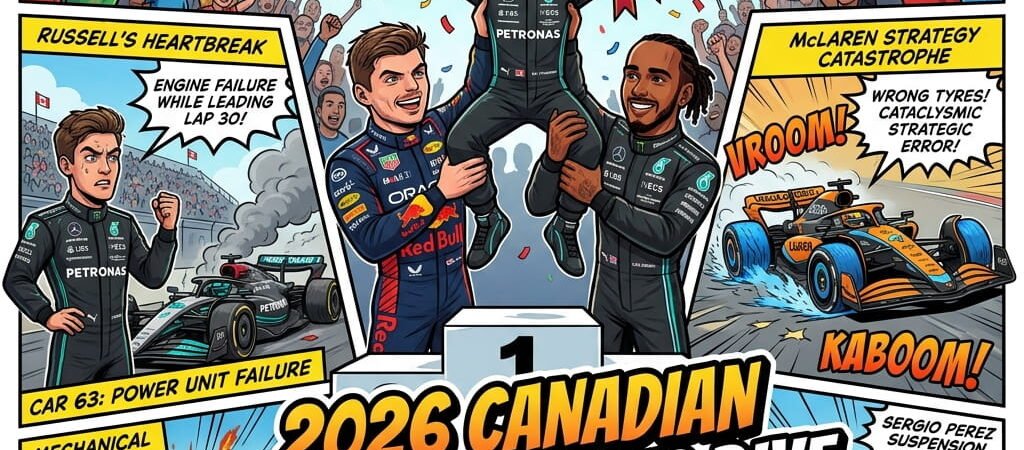

In One Sentence: Kimi Antonelli secured the 2026 Canadian Grand Prix victory following George Russell’s engine failure. Read our tactical analysis of the Mercedes battle and McLaren strategy
See the key visuals
Listen to this episode of the The AI-thletic:
Introduction
2026 Canadian Grand Prix: Antonelli Capitalises on Mercedes Chaos in Montreal
Kimi Antonelli won the 2026 Canadian Grand Prix after a Lap 30 power unit failure forced race leader George Russell to retire. The Circuit Gilles-Villeneuve witnessed a brutal war of attrition where only four cars finished on the lead lap. This weekend fundamentally altered the trajectory of the World Championship battle.
Mercedes dominated the pace, but their internal fight ended abruptly. McLaren eliminated themselves from contention entirely through a catastrophic tyre choice on a drying track. The podium provided a viral passing of the torch as Lewis Hamilton and Max Verstappen hoisted Antonelli into the air. This analysis examines the fluid dynamics that dictated Sunday’s outcome and what the telemetry reveals about the current pecking order.
Quick summary
Why did George Russell retire from the race?
George Russell retired on Lap 30 due to a sudden power unit failure while actively battling Kimi Antonelli for the lead. The mechanical fault occurred instantly and forced him to pull over alongside the track.
How did McLaren ruin their strategy?
McLaren incorrectly fitted intermediate tyres to Lando Norris and Oscar Piastri on a dry track. This poor strategic decision caused rapid thermal degradation, forcing early pit stops that destroyed their race pace and track position.
Who finished on the podium in Montreal?
Kimi Antonelli finished first, Lewis Hamilton took second place, and Max Verstappen secured third 1. Hamilton managed a late overtake on Verstappen to claim the runner-up spot in the closing laps.
1. The Mercedes Civil War and Russell’s Lap 30 Demise
The intra-team battle at Mercedes defined the first half of the Canadian Grand Prix. George Russell and Kimi Antonelli exchanged the lead multiple times in a fierce fight. Antonelli was able to utilise the slipstream effect on the back straight to stay within striking distance. Russell maintained a slight advantage in the low-speed traction zones.
On Lap 30, Russell’s power unit suffered a catastrophic failure. The sudden loss of drive eliminated the senior driver and handed Antonelli an untroubled path to victory. Fan sentiment heavily favoured the British driver, reflecting the cruelty of the mechanical sport.
“Poor George. He was prevailing against his teammate in honest wheel-to-wheel racing, only to be taken out by a random mechanical failure.” 2
2. McLaren’s Thermal Degradation Catastrophe
McLaren committed a critical error by evaluating track conditions incorrectly. Starting Lando Norris and Oscar Piastri on intermediate tyres while the racing line was dry created immediate thermal problems. Thermal degradation is a process where the tyre rubber overheats and blisters due to excessive friction on an unsuitable surface. The softer rubber compound quickly deteriorated under the heavy traction demands of the Montreal circuit.
Piastri later collided with Alex Albon, resulting in a penalty, while Norris retired entirely due to a gearbox issue. The team sacrificed guaranteed points by trying to predict rain that never materialised during the opening stint.
3. Suspension Failures and the Brutal Attrition Rate
Only four cars managed to complete all 70 laps. The severe kerbs at the Circuit Gilles-Villeneuve proved disastrous for the new 2026 ground-effect chassis regulations. Sergio Perez retired when his suspension collapsed at low speed.
The stiff suspension setups required to maximise underfloor downforce leave the carbon fibre wishbones highly vulnerable to repetitive high-frequency impacts. Teams must address this structural fragility before the next high-kerb circuit. Aston Martin also suffered a bizarre failure when Fernando Alonso retired due to a broken seat.
4. Antonelli’s Championship Dominance Validated
Kimi Antonelli now holds a 43-point lead in the Drivers’ Championship after securing his fourth consecutive victory. The young Italian inherited the lead under a Virtual Safety Car and comfortably stretched his advantage to over 10 seconds.
Unlike previous races where strategy dictated the outcome, Antonelli matched Russell’s pure pace on raw merit. The online fan reaction heavily debated whether Russell’s engine failure masked a race where Antonelli was genuinely faster. Telemetry suggests Antonelli possessed superior tyre management through the medium-speed transitions.
5. A Generational Shift on the Podium
Lewis Hamilton and Max Verstappen lifting Kimi Antonelli onto their shoulders created an instant historical image. Fans across social media platforms praised the visible respect shown by the established champions toward the current points leader.
Hamilton passed Verstappen late in the race to secure second place, putting the two most decorated drivers of the modern era on either side of the rookie. The visual framing captured a definitive changing of the guard.
Frequently asked questions
Who caused the Virtual Safety Car in Montreal?
The Virtual Safety Car was deployed to clear debris from the track after several cars suffered mechanical failures. Kimi Antonelli used this period to make his pit stop and solidify his race lead.
How many points is Antonelli leading by?
Kimi Antonelli holds a 43-point lead in the 2026 World Championship standings following the Canadian Grand Prix. This result marks his fourth consecutive race win of the season.
Why did Sergio Perez retire?
Sergio Perez suffered a sudden suspension collapse which forced him to retire his car. The failure occurred at low speed without any prior contact with the barriers.
My final thoughts
The 2026 Canadian Grand Prix highlighted the extreme mechanical stress placed on modern Formula 1 machinery. Mercedes delivered the fastest package but suffered a severe reliability blow on one side of the garage. George Russell dropping out of a commanding position demonstrates that pure speed is irrelevant without mechanical durability.
McLaren will face internal scrutiny after thoroughly misreading the track evolution. A strategy based on intermediate tyres during a dry start is an inexcusable miscalculation at this level of competition. The top teams are currently separated by fine margins, making unforced errors highly punitive.
Kimi Antonelli operates with an execution level far beyond his experience. If the Mercedes W17 remains reliable, the 43-point gap he has established will become mathematically difficult for his rivals to overcome.
Discussion points to consider
- Did George Russell push his power unit too hard while defending against Kimi Antonelli during the opening stint?
- Should McLaren reorganise their strategy department after making such a rudimentary tyre selection error?
- Will the FIA need to intervene regarding suspension designs given the dangerous low-speed collapses seen this weekend?
| Driver (Team) | Final Result | Defining Race Incident | Broader Impact |
|---|---|---|---|
| Kimi Antonelli (Mercedes) | 1st (1:28:15.758) | Capitalised on Lap 30 Virtual Safety Car; executed flawless medium-speed tyre management. | Secured 4th consecutive win; extended Drivers’ Championship lead to 43 points. |
| Lewis Hamilton (Ferrari) | 2nd (+10.768s) | Executed a late-race overtake on Verstappen to claim the runner-up spot. | Created a viral, generational photograph by hoisting Antonelli on the podium. |
| Max Verstappen (Red Bull) | 3rd (+11.276s) | Lacked ultimate straight-line speed to defend against Hamilton in the closing laps. | Minimised points deficit; displayed significant sportsmanship in post-race celebrations. |
| George Russell (Mercedes) | DNF (Lap 30) | Suffered a sudden, catastrophic power unit failure while actively fighting for the lead. | Surrendered crucial points to his teammate; raised urgent Mercedes reliability concerns. |
| Lando Norris (McLaren) | DNF (Gearbox) | Fitted with intermediate tyres on a dry track line, causing immediate thermal degradation. | Highlighted fundamental flaws in McLaren’s pit-wall weather forecasting and strategy. |
| Sergio Perez (Red Bull) | DNF (Suspension) | Experienced a low-speed structural collapse without prior barrier contact. | Exposed the extreme vulnerability of 2026 ground-effect chassis over high-frequency kerbs. |